
Etch 1.7.0 Update: Yoast SEO and Rank Math Compatibility
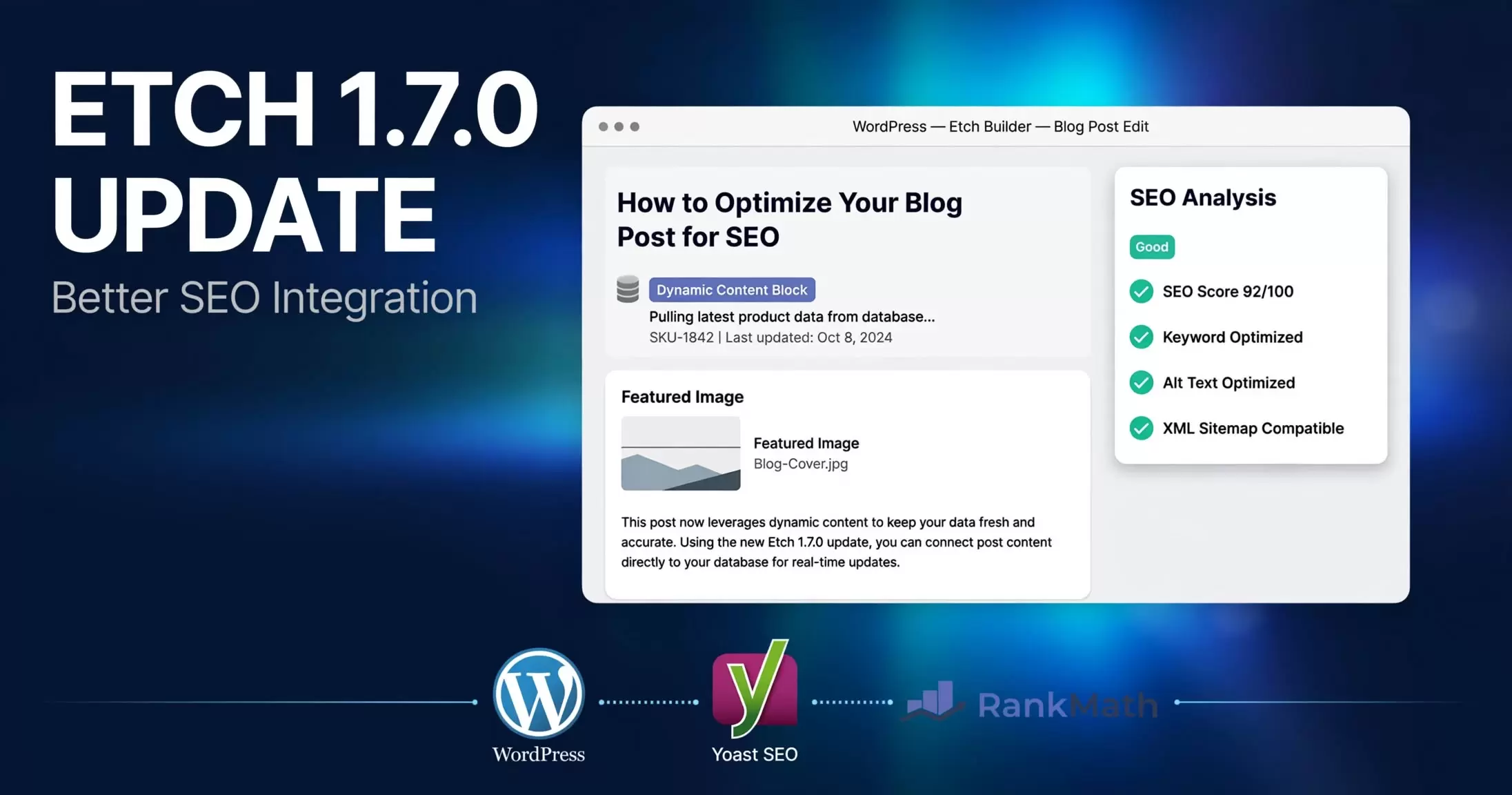
Etch 1.7.0 brings an important improvement for WordPress users who build websites with dynamic content. The latest release improves compatibility with Yoast SEO and Rank Math, allowing both plugins to analyze the content that Etch blocks actually render in the WordPress block editor.
This update addresses a common challenge for visual website builders. You can create a well-structured page with headings, paragraphs, images, and dynamic data, but your SEO plugin may not always recognize everything your builder outputs. That can make content analysis less useful than it should be.
With version 1.7.0, Etch improves how its content works with SEO analysis and image sitemaps. The update also preserves existing Yoast sitemap customizations, which is particularly useful for websites that rely on custom code.
Here is everything you need to know about the Etch 1.7.0 release, including its new features, practical benefits, and what they mean for your WordPress SEO workflow.
What Is New in Etch 1.7.0?
According to the official Etch changelog, version 1.7.0 was released on October 8, 2026. It focuses on improving the integration between Etch, Yoast SEO, and Rank Math.
The release includes five new features and one improvement.
- Rendered content analysis: Yoast SEO and Rank Math can analyze the rendered output of Etch blocks, including dynamic content.
- Improved word counts and keyphrase checks: SEO analysis now accounts for the text generated by Etch blocks.
- Image and alt text detection: SEO analysis can recognize images and their alt text in rendered Etch content.
- Automatic content analysis updates: Analysis updates as you edit, without requiring you to copy Etch content into another field.
- Improved image sitemaps: Yoast SEO and Rank Math image sitemaps can include images rendered by Etch blocks, with dynamic image sources resolved for each indexed post.
- Yoast filter compatibility: Existing image URL and image-data filters continue to work with sitemap customizations.
These changes make SEO analysis more closely reflect the content your website actually produces.
1. Yoast SEO and Rank Math Can Now Analyze Rendered Etch Content
The biggest change in Etch 1.7.0 is improved content analysis in the WordPress block editor.
Yoast SEO and Rank Math use content analysis to help website owners evaluate their pages. They examine factors such as text, headings, keyword usage, and images to provide recommendations.
However, visual builders can introduce an extra layer between the content stored in the editor and the HTML displayed on the website. Dynamic values and reusable templates can make this process more complicated.
Etch 1.7.0 addresses this issue by providing the rendered HTML behind its blocks to both SEO plugins. This allows their analysis tools to inspect the content Etch generates rather than relying only on the text directly available in the editor.
How Does Rendered Content Analysis Work?
Imagine that you run a WordPress blog about website development. You use Etch to create a reusable article template with a heading, introduction, author information, and featured image.
Some of these elements may come from dynamic WordPress data rather than manually entered text.
For example, your template might display a post title dynamically. When you open an article about website optimization, the template uses that article’s title instead of a fixed heading.
With the improved integration, Yoast SEO and Rank Math can analyze the rendered Etch content, including supported dynamic content.
This helps the SEO analysis reflect the content your template produces.
Why Does This Matter for WordPress Users?
If you build pages with reusable components or dynamic templates, you want your SEO tools to understand the resulting content.
The update helps bridge the gap between visual editing and SEO analysis. You can continue building pages with Etch while using familiar SEO plugins to review your content.
Keep in mind that better content recognition does not automatically improve search rankings. It helps your SEO plugin provide more relevant feedback, while your content quality, technical setup, and overall optimization still matter.
2. Word Counts and Focus Keyphrase Checks Now Include Etch Content
The second improvement concerns two familiar SEO features: word counts and focus keyphrase checks.
Both can become less useful when an SEO plugin cannot properly recognize text generated by a visual builder.
Etch 1.7.0 improves this process by accounting for the text that Etch blocks output.
More Complete Word Counts
Word count helps you understand how much written content a page contains. Although word count alone does not determine search rankings, it can help you evaluate whether a page provides enough information to satisfy its intended purpose.
Suppose you create an article template in Etch that displays a dynamic introduction, article heading, and other text. If the SEO analysis misses some of that output, its assessment may not reflect the full content.
The new integration helps Yoast SEO and Rank Math account for the text generated by Etch blocks.
This is especially useful when your website uses reusable layouts or dynamically generated content.
Better Focus Keyphrase Checks
A focus keyphrase is the main search phrase you want a page to target.
For example, if you publish an article about improving WordPress performance, your focus keyphrase might be “WordPress performance optimization.”
Your SEO plugin checks whether the phrase appears in relevant parts of the content and uses that information to provide recommendations.
Now imagine that a heading or paragraph containing your target phrase comes from an Etch block. The improved integration allows the plugin to consider the rendered text during its analysis.
This makes keyphrase checks more useful for websites that rely on dynamic content.
However, keyword placement still requires editorial judgment. Adding a phrase to every heading or paragraph can make your writing unnatural. Use your target keyword where it helps readers understand the topic, and include related terms when they fit the discussion.
3. Etch 1.7.0 Improves Image SEO and Alt Text Detection
Images play an important role in many WordPress websites. They make articles easier to understand, support product descriptions, and help visitors navigate visual content.
However, search engines cannot interpret every image in the same way a person does. Image metadata, surrounding text, and alternative text can provide useful context.
Etch 1.7.0 improves SEO analysis by allowing Yoast SEO and Rank Math to detect images and alt text rendered by Etch blocks.
What Is Alt Text?
Alt text is a written description associated with an image through its HTML alt attribute.
It helps screen reader users understand the purpose or content of an image. It can also provide search engines with additional information about the image.
For example, a website about web development might include an image showing a WordPress dashboard.
A useful alt attribute could be:
alt="WordPress dashboard showing website performance settings"
This description explains what the image depicts instead of repeating a generic phrase such as “image 1.”
Not every image needs a lengthy description. Decorative images should generally use an empty alt attribute, while informative images should have descriptions that match their purpose.
How the New Image Detection Works
Consider a blog template that displays a featured image through an Etch Dynamic Image element.
Etch generates the final image markup when it renders the page. According to the Etch Dynamic Image documentation, the element supports attributes such as alt, src, srcset, and sizes.
The 1.7.0 update improves the way SEO analysis recognizes images and their alt text in the rendered output.
As a result, Yoast SEO and Rank Math can take Etch-generated images into account when analyzing content.
This is useful if you manage many posts through reusable templates because you do not have to rely exclusively on images entered as ordinary text or blocks.
Remember that detecting an image is not the same as confirming that its alt text is meaningful. Review your images to ensure that their descriptions accurately reflect their content and purpose.
4. SEO Analysis Updates as You Edit Your Etch Content
Another useful feature in Etch 1.7.0 is the improved editing workflow.
Previously, users could encounter situations where they needed to copy content generated by Etch into another field so that an SEO plugin could analyze it properly.
The new integration removes that manual copying step for the supported content analysis workflow.
A Simpler Content Optimization Process
Imagine that you are preparing a new blog post.
You add a heading, write an introduction, include a dynamic image, and adjust your target keyphrase. You then change a paragraph to make the explanation clearer.
With Etch 1.7.0, the content analysis can update as you edit, allowing you to review the SEO feedback without manually transferring the Etch content into a separate field.
This creates a more direct workflow:
- Build or edit your content in Etch.
- Review the SEO analysis provided by Yoast SEO or Rank Math.
- Make relevant changes to your text, headings, or images.
- Review the updated analysis as you continue editing.
The goal is to reduce unnecessary steps between writing and optimization.
It is still important to read the recommendations critically. SEO plugins provide guidance, but they cannot fully judge whether your article answers the reader’s question, explains a difficult concept clearly, or provides original insights.
5. Etch Images Can Now Appear in Yoast SEO and Rank Math Image Sitemaps
Etch 1.7.0 also improves image sitemap generation, which matters for websites that use dynamic images.
An image sitemap helps search engines discover images associated with your website’s pages. Yoast SEO and Rank Math can generate sitemaps that include image information.
Before this update, images rendered through Etch blocks could be missing from the image sitemap in situations where the integration did not recognize their output.
The new release allows both plugins to include images rendered by Etch blocks. It also resolves dynamic image sources for each indexed post.
Understanding Dynamic Image Sources
A dynamic image source allows a website to select an image based on the current post or another data value.
For example, you might create one Etch template for every article on a technology website. Instead of manually selecting the same image for each page, the template displays the featured image associated with the current post.
Your website could contain the following articles:
- Article A uses
featured-image-a.jpg. - Article B uses
featured-image-b.jpg. - Article C uses
featured-image-c.jpg.
Although all three articles share the same template, each article displays a different image.
The sitemap needs to account for the actual image associated with each relevant post. Etch 1.7.0 improves this process by resolving dynamic image sources for individual indexed posts.
This allows Yoast SEO and Rank Math to include the corresponding Etch-rendered images in their image sitemaps.
Why Image Sitemap Support Matters
Image sitemap support can help search engines discover images that might otherwise be harder to identify through their usual crawling process.
This can be particularly useful for:
- Blogs that use dynamic featured images.
- Websites with reusable Etch templates.
- Content-heavy websites with many published articles.
- Websites that rely on dynamically generated image URLs.
However, inclusion in an image sitemap does not guarantee that a search engine will index an image or display it in image search results. Search engines make their own indexing and ranking decisions.
You should also verify that your images are publicly accessible, their URLs work correctly, and your site’s indexing settings allow search engines to access the relevant pages.
6. Existing Yoast Sitemap Customizations Continue to Work
The final item in the Etch 1.7.0 changelog is an improvement for developers and website owners who customize Yoast SEO.
Yoast provides filters that developers can use to modify image URLs and image-related data in generated sitemaps.
Custom filters can support a variety of requirements, including custom image handling and changes to the data included in sitemap output.
When an integration adds new image-processing behavior, developers need to ensure that existing customization hooks continue to work.
Etch 1.7.0 explicitly respects Yoast’s image URL and image-data filters.
What Does This Mean in Practice?
Suppose your website uses custom PHP code to modify the image URLs included in a Yoast image sitemap.
You might have a specific image-processing workflow or custom logic that determines which image URL should appear in the generated sitemap.
With the new release, Etch’s improved image sitemap integration is designed to respect those existing filters instead of bypassing them.
This helps preserve the behavior of established sitemap customizations while adding support for Etch-rendered images.
For developers, that means less concern about the new integration interfering with existing sitemap logic.
If you maintain a customized WordPress website, you should still test the generated sitemap after updating Etch. Confirm that the expected images appear, custom URLs remain correct, and any relevant filter callbacks continue to run as intended.
Who Should Update to Etch 1.7.0?
Etch 1.7.0 is particularly relevant to WordPress users who combine Etch with Yoast SEO or Rank Math.
You may benefit from this release if you:
- Build WordPress pages with dynamic content.
- Use reusable Etch templates for blog posts or other content types.
- Depend on SEO content analysis while editing.
- Use dynamic images or featured images in Etch blocks.
- Want Etch-rendered images included in your image sitemaps.
- Maintain custom Yoast image URL or image-data filters.
If you use Etch without either of these SEO plugins, the SEO integration features may not directly affect your current workflow. The update’s main focus is compatibility with Yoast SEO and Rank Math.
Before updating a production website, follow your usual backup and testing process. After installation, open a representative post, review the SEO analysis, check dynamic images, and inspect the generated image sitemap.
These checks can help you confirm that the new behavior works as expected on your particular website.
Does Etch 1.7.0 Improve Google Rankings?
Etch 1.7.0 improves how Yoast SEO and Rank Math analyze rendered content and how their image sitemaps handle Etch-generated images.
These changes can help website owners identify content issues and make important images easier for search engines to discover.
However, the update does not guarantee higher Google rankings.
Search performance depends on several factors, including content quality, search intent, site structure, technical accessibility, competition, and the overall usefulness of a page.
The best way to use these improvements is to treat SEO analysis as a practical aid rather than a substitute for good editorial decisions. Write useful content, use descriptive alt text where appropriate, ensure that important pages are accessible, and monitor your website’s search performance over time.
Final Verdict: Is Etch 1.7.0 Worth Your Attention?
Etch 1.7.0 is a meaningful compatibility update for WordPress websites that use Yoast SEO or Rank Math.
Its main benefit is straightforward: your SEO tools can work more effectively with the content Etch actually renders.
The release improves content analysis, word counts, focus keyphrase checks, image and alt text detection, and image sitemap generation. It also removes the need to manually copy Etch content into another field for the supported analysis workflow.
Developers also benefit from the continued support for Yoast’s image URL and image-data filters, which helps preserve existing sitemap customizations.
If your website relies on dynamic templates, reusable layouts, or dynamically selected images, this release deserves attention. Update through your normal testing process, verify the results on your own site, and use the improved analysis to make informed SEO decisions.
For the complete list of changes, visit the official Etch changelog.
Frequently Asked Questions
What is new in Etch 1.7.0?
Etch 1.7.0 improves compatibility with Yoast SEO and Rank Math. The update adds rendered content analysis, more complete word counts and focus keyphrase checks, image and alt text detection, automatic analysis updates, improved image sitemap support, and continued compatibility with Yoast's image URL and image-data filters.
Does Etch 1.7.0 support Yoast SEO?
Yes. The release improves how Yoast SEO analyzes content rendered by Etch blocks, including supported dynamic content. It also improves image sitemap support and preserves existing Yoast image URL and image-data filter customizations.
Does Etch 1.7.0 work with Rank Math?
Yes. The release improves compatibility with Rank Math by allowing it to analyze rendered Etch content, account for text generated by Etch blocks, detect rendered images and alt text, and include Etch-rendered images in its image sitemap.
Does Etch 1.7.0 automatically improve SEO rankings?
No. The update improves the information available to SEO analysis tools and helps search engines discover images through sitemaps. Rankings still depend on content quality, relevance, technical SEO, competition, and other factors.
Do I need to copy Etch content into another field for SEO analysis?
The new integration removes the need to manually copy Etch content into another field for the supported content analysis workflow. SEO analysis can update as you edit your content.
Can Etch 1.7.0 include dynamic images in image sitemaps?
Yes. The release allows Yoast SEO and Rank Math image sitemaps to include images rendered by Etch blocks, with dynamic image sources resolved for each indexed post.
Will Etch 1.7.0 break my existing Yoast sitemap customizations?
The release explicitly respects Yoast's image URL and image-data filters to keep existing sitemap customizations working. If your website uses custom code, testing the generated sitemap after updating remains a sensible precaution.