
Which Task Is a Generative AI Task? Answer and Examples
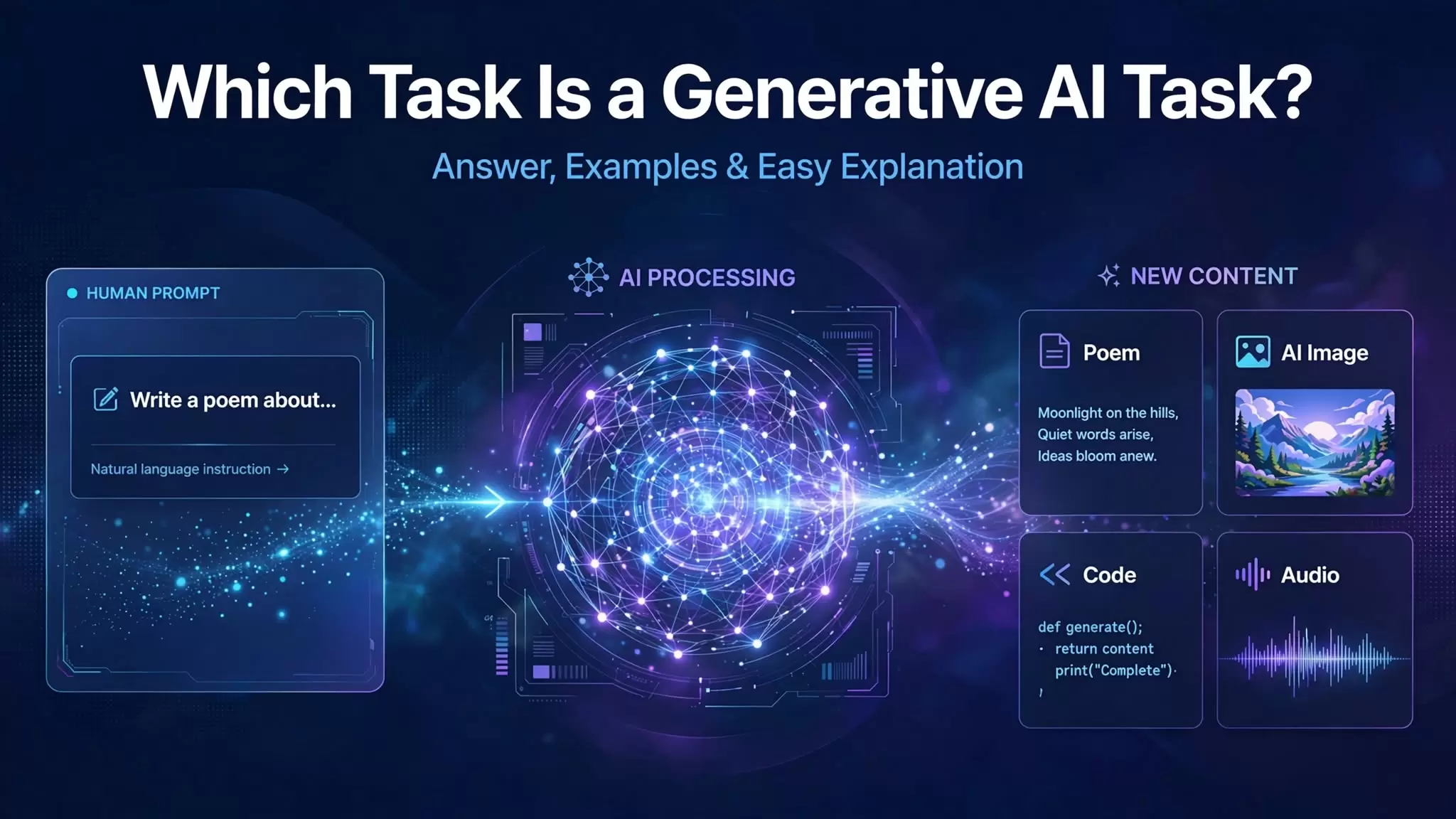
If you are searching for “Which task is a generative AI task?”, you probably want a quick answer first.
Writing a poem based on a given theme is a generative AI task.
Why? Because the AI creates new content based on an instruction. In this case, it generates a new poem from the theme or prompt you provide.
That same idea applies to many everyday AI tasks. Writing an email, creating an image, generating computer code, composing music, and producing a video can all involve generative AI because the system creates a new output rather than simply identifying or calculating something that already exists.
AWS describes generative AI as AI that creates new content and ideas, including text, images, video, music, and other forms of content.
Quick Answer: Which Task Is a Generative AI Task?
If this is a multiple-choice question, look for the option that asks the AI to create something new.
For example:
-
Calculating the total word count in an article
-
Identifying the main topic of a news article
-
Detecting credit card fraud
-
Writing a poem based on a given theme
The correct answer is:
Writing a poem based on a given theme.
The AI has to create original text in response to the theme. The other tasks mainly involve calculation, classification, detection, or analysis.
This exact question and answer also appear in educational question banks, including a version that lists these four options and identifies writing a poem as the generative AI task.
What Makes a Task Generative AI?
The easiest way to understand generative AI is to focus on the output.
Ask yourself:
Does the AI need to create a new output from the information or instructions it receives?
If yes, you are probably looking at a generative AI task.
For example, if you tell an AI:
Write a short poem about a rainy evening.
The AI generates new text that answers your request.
The same principle works with other content:
-
“Create an image of a mountain village at sunrise.”
-
“Write a product description for these shoes.”
-
“Generate Python code for a calculator.”
-
“Draft an email to a customer.”
-
“Create a short story about a lost astronaut.”
In each case, the system generates an output.
AWS also distinguishes generative AI from traditional AI systems by describing generative AI as a technology that creates new content, while traditional AI systems often focus on tasks such as classification and prediction.
Why Is Writing a Poem a Generative AI Task?
Writing a poem requires content creation.
The user provides a theme, idea, style, or other instructions. The AI then generates words and sentences that form a new poem.
For example, you might enter:
Write a four-line poem about the first rain of summer.
The AI does not simply calculate an answer or select a category. It produces a piece of writing based on your request.
That makes it a clear example of generative AI.
Generative AI can create many other types of content too. These include text, images, code, audio, and video.
Why the Other Options Are Not Generative AI Tasks
Understanding the incorrect options makes the answer much easier to remember.
Calculating the total word count
Counting the words in an article is a calculation.
The system takes existing information and produces a numerical result. It does not need to create a new piece of content.
For example, if an article contains 1,250 words, a word-count tool simply returns the number.
That is not a typical generative AI task.
Identifying the main topic of an article
Suppose an AI reads an article and determines that its main topic is climate change.
The article already exists. The AI identifies or classifies information that is already there.
It does not create a new article or other piece of content.
That makes the task analytical or classificatory rather than generative.
Detecting credit card fraud
Fraud detection usually involves examining transactions and identifying suspicious activity.
A system may use machine learning to classify a transaction as legitimate or suspicious. It may also calculate a risk score or probability.
The goal is detection or prediction, not content generation.
AWS describes traditional AI systems as commonly handling classification, prediction, or optimization tasks, while generative AI creates new content.
Writing a poem
Writing a poem is different because the AI creates new text based on the user’s instructions.
That is why this is the correct answer.
A Simple Test for Identifying Generative AI Tasks
You do not need to memorize a long technical definition.
Use this simple question:
“Is the AI creating something new?”
If the answer is yes, the task is likely generative.
| Task | Generative AI? | Main reason |
|---|---|---|
| Writing a poem | Yes | Creates new text |
| Writing an email | Yes | Generates new text |
| Creating an image | Yes | Generates visual content |
| Writing code | Yes | Produces new code |
| Creating music | Yes | Generates audio content |
| Creating a video | Yes | Generates video content |
| Counting words | No | Performs a calculation |
| Detecting fraud | Usually no | Detects or classifies activity |
| Identifying an article topic | Usually no | Analyzes existing information |
| Sorting emails into categories | Usually no | Classifies existing information |
| Predicting sales | Usually no | Produces a prediction |
This test works well for basic AI quizzes because it focuses on what the task asks the system to produce.
Generative AI vs Traditional AI
The difference becomes much clearer when you look at the desired result.
Generative AI creates content.
Traditional AI and other automated systems can classify, predict, detect, calculate, or optimize.
For example, imagine a customer service system.
If the system identifies whether an incoming message is a complaint or a refund request, it performs classification.
If the system writes a personalized response to that customer, it performs a generative task.
The same application can therefore contain both generative and non-generative tasks.
This is an important distinction because using an AI tool does not automatically make every task generative AI.
The task itself matters.
Examples of Generative AI Tasks
Once you understand the basic idea, you can recognize generative AI tasks in everyday work.
Writing and content creation
AI can generate:
-
Blog drafts
-
Emails
-
Product descriptions
-
Stories
-
Poems
-
Advertisements
-
Social media captions
-
Scripts
Image creation
A user can describe an image and ask an AI system to create it.
For example:
Create a realistic image of a small café beside a lake during sunset.
The output is newly generated visual content.
Code generation
Developers can describe what they want a program to do and ask an AI system to produce code.
For example:
Create a Python function that checks whether a number is prime.
The AI generates code in response to the request.
Summarization
Generative AI can also summarize existing information.
This case can confuse beginners because the source material already exists.
However, the AI can generate a new summary from that material. The summary itself is newly produced text.
Study.com includes summarization, synthesis, and drafting among tasks that can make sense for generative AI, while also emphasizing the importance of human judgment when accuracy or risk matters.
Brainstorming
You can also ask generative AI to produce:
-
Business ideas
-
Article topics
-
Marketing concepts
-
Names
-
Headlines
-
Story ideas
-
Product ideas
The system generates possible outputs based on your instructions.
Are All AI Tasks Generative AI Tasks?
No.
This is one of the most important points to understand.
A company might use AI to detect spam, predict customer behavior, recommend products, classify documents, or identify objects in images.
Those applications can involve AI without being generative AI tasks.
For example:
Task: Identify whether an email is spam.
The system chooses a category.
Task: Write a reply to the email.
The system creates new content.
The first task is classification. The second is generation.
AWS similarly explains that traditional AI systems can handle classification and prediction, while generative AI produces new content such as text, images, and code.
Can Generative AI Perform Non-Generative Tasks?
Yes.
This distinction is important because a generative AI model can sometimes perform tasks that do not look generative.
For example, you can ask a language model to classify customer messages as:
-
Complaint
-
Question
-
Refund request
-
Feedback
The model may successfully perform the classification.
However, the task itself remains a classification task.
So when a question asks “Which task is a generative AI task?”, do not simply look for the word “AI.”
Look at what the system must actually do.
When Is Generative AI Useful?
Generative AI tends to fit tasks that involve drafting, creating, transforming, summarizing, or brainstorming content.
Study.com notes that task suitability depends on factors such as the type of task, accuracy requirements, risk, and the amount of human oversight available. It specifically identifies drafting, synthesis, and ideation as areas where generative AI can provide value.
For everyday work, that might include:
-
Creating a first draft of an article
-
Brainstorming marketing ideas
-
Rewriting text for a different audience
-
Summarizing a long document
-
Drafting customer emails
-
Creating code examples
-
Developing content ideas
However, AI-generated content still needs appropriate review.
An AI system can produce incorrect information, misunderstand context, or present an uncertain answer with confidence. For high-stakes subjects, people should verify important information and apply human judgment before relying on the output.
A Five-Second Trick for AI Exam Questions
If you are preparing for an AI certification exam, course, or interview, try this approach.
First, look at the output.
Then ask:
Is the system creating something new?
If the answer is yes, the option probably describes a generative AI task.
If the option says the system will:
-
Calculate something
-
Detect something
-
Classify something
-
Sort something
-
Predict something
-
Identify something
look more carefully. Those tasks generally describe calculation, detection, classification, or prediction rather than content generation.
For the question in this article, the reasoning is straightforward:
Calculating word count = calculation
Identifying an article topic = classification or analysis
Detecting credit card fraud = detection or classification
Writing a poem = content generation
Therefore:
Writing a poem based on a given theme is the generative AI task.
Final Answer
So, which task is a generative AI task?
Writing a poem based on a given theme.
The reason is simple: the AI creates new text from the user’s instructions.
Calculating a word count involves computation. Identifying an article’s topic involves analysis or classification. Detecting credit card fraud involves detection or classification. Writing a poem requires the AI to generate new content.
The easiest rule to remember is:
Generative AI creates new content.
Once you focus on the output rather than simply asking whether the task uses AI, these questions become much easier to solve.
Frequently Asked Questions
What is an example of a generative AI task?
Writing a poem, creating an image, generating code, drafting an email, and composing music are examples of generative AI tasks because the system produces new content.
Is writing a poem a generative AI task?
Yes. Writing a poem requires the system to generate new text based on a theme or prompt.
Is detecting credit card fraud generative AI?
Not typically. Fraud detection generally focuses on identifying suspicious transactions or assigning a risk classification rather than generating new content.
Is calculating word count a generative AI task?
No. Counting words is a calculation. The system produces a numerical result rather than newly generated content.
Is identifying the topic of an article generative AI?
Not usually. Identifying a topic involves analyzing and classifying existing information.
Is summarizing a document generative AI?
It can be. A generative AI system can create a new summary from an existing document. The source already exists, but the summary is newly generated.
What is the easiest way to identify a generative AI task?
Ask whether the task requires the AI to create new content. If it needs to write, draw, compose, generate, or otherwise produce a new output, it is likely a generative task.
Can the same AI tool perform both generative and non-generative tasks?
Yes. The same AI system can generate text in one situation and classify information in another. The nature of the task determines how you should describe it.